Current metrics: what the selection step loses today, and on whose clock
This page measures the loss at the last step of the gig funnel: an applicant exists, nobody selects them, and the job expires. It is the first page of the auto-select timing initiative. Every number comes from the nightly copy of production, jodgig_ai. Unless a table says otherwise, the window is shifts starting 22 June to 13 September 2026, twelve full weeks, the period since the outlet flag was switched on for every outlet. Every key number carries one of three tags: fact from data, replay estimate, or assumption.
Terms used on this page:
| term | meaning |
|---|---|
| no-selection job | a jod_jobs row with status: 8: it expired, it had applicants, nobody selected any of them. One row is one worker position. |
| live eligible applicant | a job_user row still in status IN (1, 10) at expiry, whose user is enabled, not deleted, and not user 100641, which the code always skips |
| a miss | a no-selection job at an outlet with locations.is_auto_select_applicant = 1 that had a live eligible applicant. This is the set auto-select could have filled. |
| normal job | posted 24 hours or more before the shift. It expires 8 hours before the shift. |
| short-notice job | posted less than 24 hours before the shift. It expires at the shift start. |
| manager-selected | hired_by_manager_id set and no genuine auto-select marker. A repost's auto_select_user_id is a copy of its parent's and does not count. |
| worked slot | a slot with a valid paid payment record. The company charge on it averaged SGD 90.89 in the window. |
1. The loss: about 59 jobs a week at outlets with the flag on, worth up to SGD 119,000 a year
| measure | value | tag |
|---|---|---|
| no-selection jobs, all outlets | 1,009 jobs, 1,062 slots, about 88 slots a week | fact from data |
| of which had a live eligible applicant | 927 | fact from data |
| misses, meaning at an outlet with the flag on | 703 jobs, about 59 a week | fact from data |
| no-selection jobs at outlets with the flag off | 224, of which 81 had an applicant waiting at the run time | fact from data |
| upper bound of the loss: every miss selected and worked, at SGD 90.89 a slot | about SGD 5,300 a week, SGD 277,000 a year | assumption |
| what the proposed rule recovers: 452 of the 703, worked at the 66.8% auto-pick completion rate | about SGD 2,300 a week, SGD 119,000 a year | replay estimate |
The impact page compares the options. The solution page explains the 452.
1.1 The number fell once, in July, and then stayed flat
No-selection slots a week, all outlets, by shift week (fact from data):
| week of | slots | week of | slots | week of | slots | week of | slots |
|---|---|---|---|---|---|---|---|
| 27 Apr | 82 | 1 Jun | 164 | 6 Jul | 121 | 10 Aug | 67 |
| 4 May | 116 | 8 Jun | 218 | 13 Jul | 100 | 17 Aug | 89 |
| 11 May | 110 | 15 Jun | 177 | 20 Jul | 84 | 24 Aug | 77 |
| 18 May | 135 | 22 Jun | 157 | 27 Jul | 61 | 31 Aug | 98 |
| 25 May | 133 | 29 Jun | 86 | 3 Aug | 74 | 7 Sep | 89 |
The flag was switched on for every outlet on 22 June. Auto-selected jobs jumped from about 70 a week to 222 that week and drifted down to 90 to 100 as outlets switched it off. At platform level the no-selection rate, no-selection jobs as a share of jobs with applicants, was 8.6% before auto-select existed (June to November 2025), 9.2% during the opt-in months, and 4.7% since 22 June 2026. The same summer weeks were 8.2% in 2024 and 7.7% in 2025, so the drop is not the season (fact from data). What did not move is the completion of the jobs that were selected, which is why the credits did not follow; the impact page has that comparison.
2. Who loses it: two companies carry 42% of the no-selection jobs
The ten companies with the most no-selection jobs in the twelve weeks (fact from data). "Outlets off" is the number of the company's outlets with the flag off on 15 September 2026. "After 24h" is the share of the company's manager selections made more than 24 hours after the first applicant.
| company | outlets (off) | jobs with applicants | no-selection jobs | share | of which short-notice | manager picks after 24h |
|---|---|---|---|---|---|---|
| McDonald's | 43 (0) | 4,816 | 232 | 4.8% | 126 | 33% |
| NTUC FairPrice (Hyper) | 5 (1) | 2,272 | 191 | 8.4% | 103 | 70% |
| NTUC FairPrice Supermarkets (North) | 12 (0) | 1,820 | 81 | 4.5% | 64 | 30% |
| NTUC Foodfare | 16 (1) | 1,646 | 46 | 2.8% | 31 | 34% |
| NTUC FairPrice Supermarkets (Northwest) | 11 (1) | 1,314 | 42 | 3.2% | 30 | 36% |
| NTUC FairPrice Supermarkets (Central) | 9 (0) | 944 | 41 | 4.3% | 37 | 29% |
| NTUC FairPrice Supermarkets (West) | 8 (0) | 405 | 36 | 8.9% | 32 | 15% |
| Winter Time | 9 (6) | 122 | 31 | 25.4% | 26 | 9% |
| Good Idea Concepts | 6 (0) | 444 | 27 | 6.1% | 25 | 5% |
| NTUC FairPrice Supermarkets (Central East) | 4 (0) | 694 | 27 | 3.9% | 19 | 34% |
The ten outlets with the most no-selection jobs (fact from data). "Applicant 6h or more" is the number of the outlet's misses where the first live applicant arrived 6 hours or more before the shift, so a rule with a 6-hour floor could have selected them.
| outlet | company | flag | jobs with applicants | no-selection jobs | share | short-notice misses | applicant 6h or more |
|---|---|---|---|---|---|---|---|
| FairPrice Xtra Changi Business Park | NTUC FairPrice (Hyper) | off, UKG | 1,631 | 155 | 9.5% | 74 | 123 |
| McDonald's Hougang 1 | McDonald's | on | 442 | 57 | 12.9% | 18 | 33 |
| FairPrice Northpoint City | FairPrice Supermarkets (North) | on, UKG | 353 | 34 | 9.6% | 25 | 24 |
| FairPrice Xtra Parkway Parade | NTUC FairPrice (Hyper) | on, UKG | 470 | 27 | 5.7% | 20 | 15 |
| FairPrice Jurong West Blk 502 | FairPrice Supermarkets (West) | on, UKG | 134 | 20 | 14.9% | 17 | 13 |
| McDonald's Plaza Singapura | McDonald's | on | 206 | 18 | 8.7% | 14 | 12 |
| FairPrice Lot 1 Shoppers' Mall | FairPrice Supermarkets (Northwest) | off, UKG | 85 | 16 | 18.8% | 10 | 13 |
| FairPrice City Square Mall | FairPrice Supermarkets (Central) | on, UKG | 181 | 15 | 8.3% | 15 | 12 |
| FairPrice Yishun MRT | FairPrice Supermarkets (North) | on, UKG | 216 | 14 | 6.5% | 11 | 5 |
| Senoko Kitchen / ICM | NTUC Foodfare | on | 529 | 13 | 2.5% | 8 | 12 |
"UKG" marks outlets whose jobs come from the UKG workforce system, so a hire needs a live UKG call. Changi Business Park switched the flag off around 11 August 2026; the impact page shows what that cost. McDonald's Hougang 1 has 21 misses with no eligible applicant left, the pattern where one jodder applies to several positions of the same shift and, once hired on one, is removed from the others.
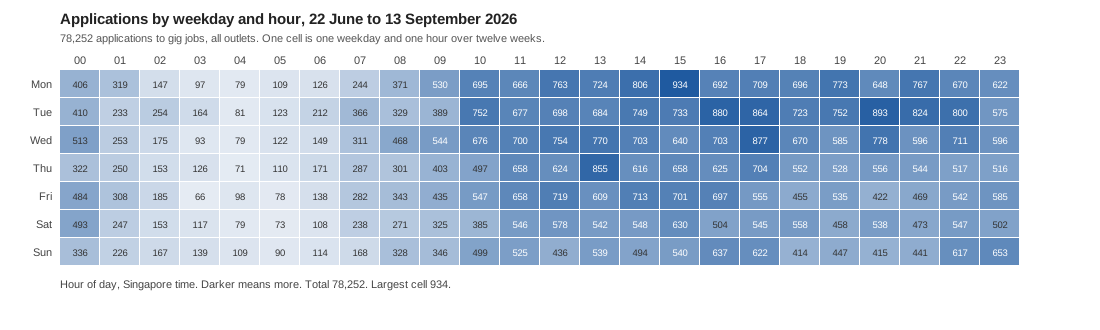
3. Jodders apply around the clock, with the peak from 15:00 to 17:00 and no drop until midnight
| clock band | applications to normal jobs | applications to short-notice jobs |
|---|---|---|
| 00:00 to 05:59 | 7,401 (10.8%) | 736 (7.4%) |
| 06:00 to 11:59 | 14,567 (21.3%) | 2,211 (22.3%) |
| 12:00 to 17:59 | 24,465 (35.8%) | 3,909 (39.4%) |
| 18:00 to 23:59 | 21,902 (32.1%) | 3,061 (30.9%) |
| total | 68,335 | 9,917 |
The busiest hours are 17:00, 15:00 and 16:00, but no hour holds more than 6.2% of applications. 42% of applications arrive outside 06:00 to 17:59. Monday and Tuesday are the busiest days. The one hour that matters most for auto-select is the one after the 17:00 run: 43,304 of the 78,252 applications (55%) arrive between 17:00 and 08:59, after the evening run and before the morning run (all fact from data).
Applications by weekday and hour, counts
| day | 00 | 01 | 02 | 03 | 04 | 05 | 06 | 07 | 08 | 09 | 10 | 11 | 12 | 13 | 14 | 15 | 16 | 17 | 18 | 19 | 20 | 21 | 22 | 23 | total |
|---|---|---|---|---|---|---|---|---|---|---|---|---|---|---|---|---|---|---|---|---|---|---|---|---|---|
| Mon | 406 | 319 | 147 | 97 | 79 | 109 | 126 | 244 | 371 | 530 | 695 | 666 | 763 | 724 | 806 | 934 | 692 | 709 | 696 | 773 | 648 | 767 | 670 | 622 | 12,593 |
| Tue | 410 | 233 | 254 | 164 | 81 | 123 | 212 | 366 | 329 | 389 | 752 | 677 | 698 | 684 | 749 | 733 | 880 | 864 | 723 | 752 | 893 | 824 | 800 | 575 | 13,165 |
| Wed | 513 | 253 | 175 | 93 | 79 | 122 | 149 | 311 | 468 | 544 | 676 | 700 | 754 | 770 | 703 | 640 | 703 | 877 | 670 | 585 | 778 | 596 | 711 | 596 | 12,466 |
| Thu | 322 | 250 | 153 | 126 | 71 | 110 | 171 | 287 | 301 | 403 | 497 | 658 | 624 | 855 | 616 | 658 | 625 | 704 | 552 | 528 | 556 | 544 | 517 | 516 | 10,644 |
| Fri | 484 | 308 | 185 | 66 | 98 | 78 | 138 | 282 | 343 | 435 | 547 | 658 | 719 | 609 | 713 | 701 | 697 | 555 | 455 | 535 | 422 | 469 | 542 | 585 | 10,624 |
| Sat | 493 | 247 | 153 | 117 | 79 | 73 | 108 | 238 | 271 | 325 | 385 | 546 | 578 | 542 | 548 | 630 | 504 | 545 | 558 | 458 | 538 | 473 | 547 | 502 | 9,458 |
| Sun | 336 | 226 | 167 | 139 | 109 | 90 | 114 | 168 | 328 | 346 | 499 | 525 | 436 | 539 | 494 | 540 | 637 | 622 | 414 | 447 | 415 | 441 | 617 | 653 | 9,302 |
| total | 2,964 | 1,836 | 1,234 | 802 | 596 | 705 | 1,018 | 1,896 | 2,411 | 2,972 | 4,051 | 4,430 | 4,572 | 4,723 | 4,629 | 4,836 | 4,738 | 4,876 | 4,068 | 4,078 | 4,250 | 4,114 | 4,404 | 4,049 | 78,252 |
4. Hiring managers keep office hours and take their time on normal jobs
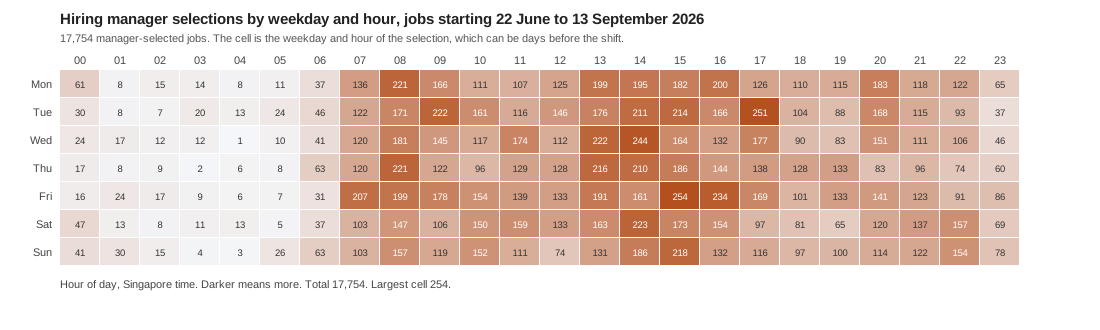
Selection time is the earliest slot_user.created_at on the job. 17,754 manager-selected jobs starting in the window, 14,929 normal and 2,825 short-notice (fact from data).
| clock band of the selection | normal jobs | short-notice jobs |
|---|---|---|
| 00:00 to 05:59 | 509 (3.4%) | 131 (4.6%) |
| 06:00 to 11:59 | 4,777 (32.0%) | 683 (24.2%) |
| 12:00 to 17:59 | 6,103 (40.9%) | 1,103 (39.0%) |
| 18:00 to 23:59 | 3,540 (23.7%) | 908 (32.1%) |
Hours from the first application on the job to the selection:
| job kind | lower quartile | median | upper quartile | within 1 hour | over 24 hours |
|---|---|---|---|---|---|
| normal | 2.1 h | 15.5 h | 44.1 h | 2,706 (18.1%) | 5,390 (36.1%) |
| short-notice | 0.03 h | 0.5 h | 2.5 h | 1,688 (59.8%) | 0 |
Hours from the selection to the shift start:
| job kind | median | under 6 hours | 6 to 24 hours | over 24 hours |
|---|---|---|---|---|
| normal | 129 h | 0 | 476 (3.2%) | 14,453 (96.8%) |
| short-notice | 8.7 h | 1,244 (44.0%) | 1,581 (56.0%) | 0 |
Three things follow. Managers select when they are at work: 71% of selections fall between 06:00 and 17:59, while 42% of applications arrive outside those hours. On a normal job they wait: a median 15.5 hours after the first applicant, and 36% wait more than a day. Their speed on short-notice jobs comes from the short notice, not from a habit: 60% select within an hour because the shift is hours away. No normal job is ever selected inside the last 6 hours, because it expired 8 hours before the shift. Only 2.1% of normal-job selections happen after the day-before run has passed, so on normal jobs the run has almost nothing left to take from a manager. On short-notice jobs 97.7% of selections come after it, because the job did not exist when the run time passed (all fact from data).
5. The two clocks do not meet where the run is
Applications keep arriving until midnight. Managers stop selecting in the evening. The one automatic attempt runs at 09:00 or 17:00 the day before the shift, before 55% of the applications, and for every shift starting before 17:00 the next morning's run comes after the job has already expired. The problems page puts the three clocks on one timeline and counts where the 703 misses fall.